
Mallorca Planer · Independent travel guide
A short break in Mallorca: how to fill three to four days well
A short break in Mallorca works if you do not try to see the whole island. With Palma as a base and one clear theme per day, there is enough time for city, mountains and sea.
Photo: Olaf Tausch, CC BY 3.0, Wikimedia Commons
Updated on 2/10/2026
In short
For a Mallorca short break of three to four days, Palma is the most practical base: the airport is eight kilometres away and the old town can be explored on foot. Day one is for Palma with the cathedral and Bellver Castle, day two for the Serra de Tramuntana by train to Sóller, day three for the caves near Porto Cristo or a beach. A fourth day goes north.
Key points
- Palma is eight kilometres from the airport and is the base with the shortest journeys.
- The cathedral, La Seu, has a nave 44 metres high and a rose window nearly 14 metres across.
- The railway from Palma to Sóller has run since 16 April 1912 over about 27 kilometres and through 13 tunnels.
- According to the operator, the Caves of Drach near Porto Cristo extend for close to 1,200 metres, with Lake Martel inside.
- In the north are the walls of Alcúdia, finished in 1362, and the 365 steps to the Calvary in Pollença.
Why Palma is the best base for a short break
With three or four days, every hour counts. The airport is eight kilometres east of Palma, so you are in the city quickly. The old town is compact, and the train to Sóller and the trains inland leave from Plaça d'Espanya. In the evening you have restaurants on the doorstep instead of sitting in a car.
If you would rather stay by the beach, there are alternatives under where to stay. On a short break, though, any base outside Palma costs travel time.
Day 1: Palma on foot
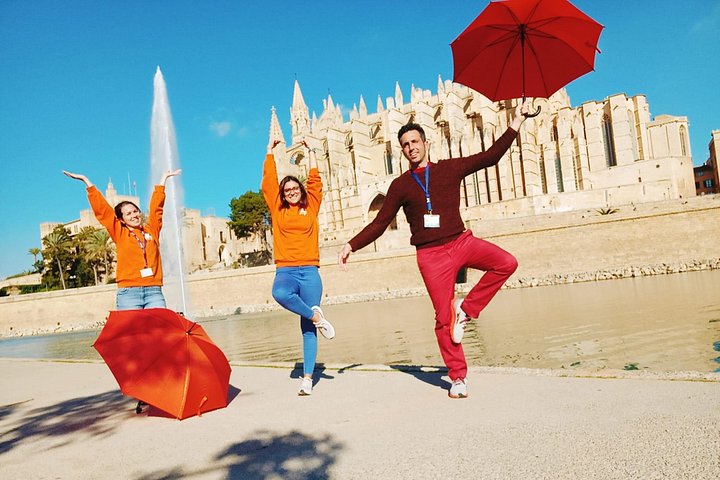
Start at the cathedral. La Seu is a Gothic building right by the sea, begun after the conquest of the island in 1229. The nave is 44 metres high and the rose window measures nearly 14 metres. Between 1903 and 1914 Antoni Gaudí reworked the interior.
Opposite stands the Royal Palace of La Almudaina, originally an Arab fortress and, according to Patrimonio Nacional, the King's official residence during his stays in Mallorca. A short walk away is the Llotja, the Gothic maritime exchange designed by Guillem Sagrera, on which building began in 1426.
The afternoon suits Bellver Castle, on a hill three kilometres west of the centre. The 14th-century castle is one of the few circular castles in Europe and houses the city history museum. More places are listed under Palma.
Day 2: by train to Sóller and into the Tramuntana
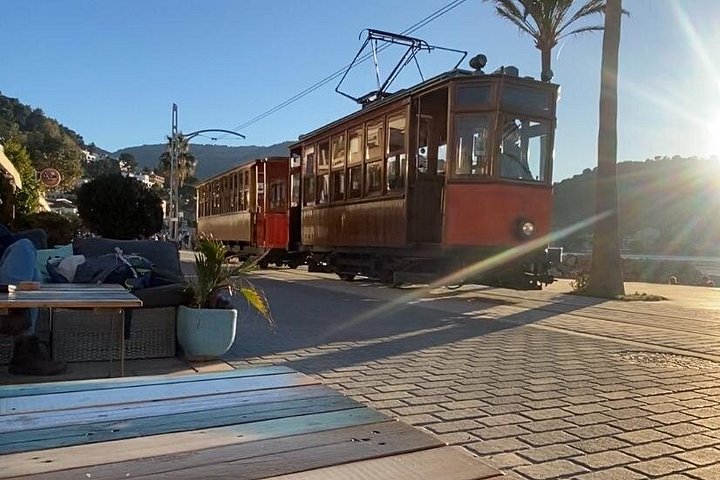
The Serra de Tramuntana has been a UNESCO World Heritage Site since 2011. The easiest way in is the Tren de Sóller. The narrow-gauge railway has run from Plaça d'Espanya to Sóller since 16 April 1912, over about 27 kilometres and through 13 tunnels.
In Sóller you change to the tram, which since 1913 has covered the nearly five kilometres to Port de Sóller. Excursion boats along the north-west coast also leave from there.
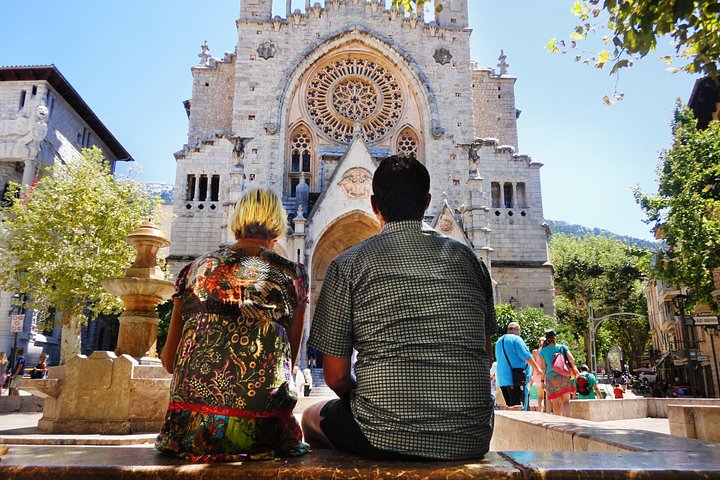
An alternative by hire car or guided tour: Valldemossa with its charterhouse, where Frédéric Chopin and George Sand spent the winter of 1838 to 1839, and the village of Deià, where the house of the poet Robert Graves is now a museum.
Day 3: caves in the east or a beach day
For the third day you have two directions. In the east, near Porto Cristo, are the Caves of Drach, a cave system that, according to the operator, extends horizontally for close to 1,200 metres. Inside is Lake Martel. The visit typically ends with a short classical concert. About one kilometre west of Porto Cristo are the Coves dels Hams, discovered in 1905.
The alternative is a day by the sea. Which beaches work from Palma and where boat trips leave from is covered on those pages.
Day 4: the north with Alcúdia and Pollença
If you have a fourth day, head north. Alcúdia is ringed by a medieval town wall that was finished in 1362. Immediately south of it are the remains of the Roman town of Pollentia.
In Pollença, 365 steps lead up to the chapel on the Calvary hill. From Port de Pollença the road continues across the Formentor peninsula to the lighthouse at Cap de Formentor. On the way is the Es Colomer viewpoint. Details are under Alcúdia and Pollença.
Practical points for a short break
- Without a car: days one and two work entirely without car hire. For days three and four, hire a car for a day or two or book guided day trips.
- Season: a short break built around city and mountains fits spring and autumn well. According to AEMET, the mean daily high in Palma is 19.2 °C in April and 23.7 °C in October.
- Rain: the cathedral, museums and caves are weatherproof. Simply swap the days according to the forecast.
- Tickets: admission and timetables change. Check them with the operators shortly before you travel.
Frequently asked questions
Are three days enough for a short break in Mallorca?
Yes, if you limit yourself. In three days you can cover Palma, a day in the Serra de Tramuntana by train to Sóller, and a day of caves or beach. You will not see the whole island in that time, because Mallorca is too big at about 3,600 square kilometres.
Where is the best place to stay for a short break in Mallorca?
For a short break Palma is the most practical base. The airport is eight kilometres away, you explore the old town on foot, and the train to Sóller and the trains inland leave from Plaça d'Espanya. That way you lose very little time on transfers.
Do you need a hire car for a short break in Mallorca?
Not for the whole stay. Palma and the train ride to Sóller work without a car. For the caves near Porto Cristo, for remote beaches and for the north, a hire car for a day or two or a guided day trip is the simplest solution.
When is the best time for a short break in Mallorca?
For a short break with city, mountains and sightseeing, April, May and October work well. According to AEMET, mean daily highs in Palma are then between 19.2 and 23.7 °C. If swimming is your priority, come between June and September.
What can you see in Palma de Mallorca in one day?
In one day in Palma you can cover the cathedral, La Seu, the Royal Palace of La Almudaina opposite, the Gothic Llotja and the lanes of the old town. The afternoon suits Bellver Castle, a circular 14th-century castle three kilometres west of the centre.
Can you get from Palma de Mallorca to Sóller without a car?
Yes. The Tren de Sóller has run since 1912 from Plaça d'Espanya in Palma to Sóller, over about 27 kilometres and through 13 tunnels. From Sóller the tram takes you the nearly five kilometres to Port de Sóller. The operator publishes timetables and fares.
Is a short break in Mallorca worth it in winter?
For Palma and the villages, yes. According to AEMET the city reaches a mean 15.4 °C by day in January, with 42 mm of rain in the month. The cathedral, museums and caves do not depend on the weather. Do not plan on a beach day in winter.
Sources
- Wikipedia (en): Palma de Mallorca Airport, checked on 2/10/2026
- Wikipedia (en): Palma Cathedral, checked on 2/10/2026
- Wikipedia (en): Royal Palace of La Almudaina, checked on 2/10/2026
- Wikipedia (de): Llotja de Palma, checked on 2/10/2026
- Wikipedia (en): Bellver Castle, checked on 2/10/2026
- Wikipedia (en): Serra de Tramuntana, checked on 2/10/2026
- Wikipedia (de): Ferrocarril de Sóller, checked on 2/10/2026
- Wikipedia (en): Tramvia de Sóller, checked on 2/10/2026
- Wikipedia (de): Port de Sóller, checked on 2/10/2026
- Wikipedia (en): Valldemossa Charterhouse, checked on 2/10/2026
- Wikipedia (en): Deià, checked on 2/10/2026
- Wikipedia (en): Cuevas del Drach, checked on 2/10/2026
- Wikipedia (en): Coves dels Hams, checked on 2/10/2026
- Wikipedia (de): Alcúdia, checked on 2/10/2026
- Wikipedia (en): Pollença, checked on 2/10/2026
- Wikipedia (de): Cap de Formentor, checked on 2/10/2026
- Wikipedia (de): Mallorca, checked on 2/10/2026
- AEMET, Valores climatológicos normales: Palma, Puerto (1981-2010), checked on 2/10/2026
- Cuevas del Drach, web del operador, checked on 2/10/2026
- Patrimonio Nacional: Palacio Real de La Almudaina, checked on 2/10/2026
Written and maintained by the Mallorca Planer editorial team. Independent travel guide, not an official body and not a travel agency.
Bookable
Activities that fit
Valldemosa and Valley of Soller Tour in Mallorca
Full dayfrom49 €

Private sailing with Paella and Tapas in Palma
4 hfrom475 €
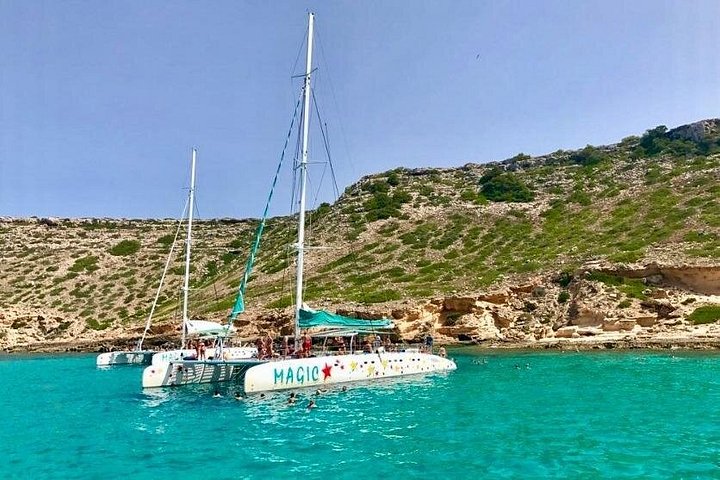
Prices are indicative from prices set by each provider. Booking happens on Viator. We earn a commission on bookings made through these links and the price for you stays the same.
Plan
Read next
PalmaPalma sits on the south coast of Mallorca, on the Bay of Palma, and is the capital of the Balearic Islands. The cathedraSerra de TramuntanaThe Serra de Tramuntana runs from south-west to north-east along the north-west coast of Mallorca. Since 2011 its culturAlcúdia and PollençaThe north of Mallorca is made up of two wide bays, the Badia de Pollença and the larger Badia d'Alcúdia, and ends at CapActivitiesHere you will find bookable day trips and activities in Mallorca, sorted by theme and region. That way you can quickly sWhere to stayIn Mallorca the region shapes your holiday more than the stars on the hotel. Pick the area that fits your plan first, thRainy dayA rainy day in Mallorca is not a lost day. The island has caves, one of the great Gothic cathedrals and enough museums a